

Amended transcript:
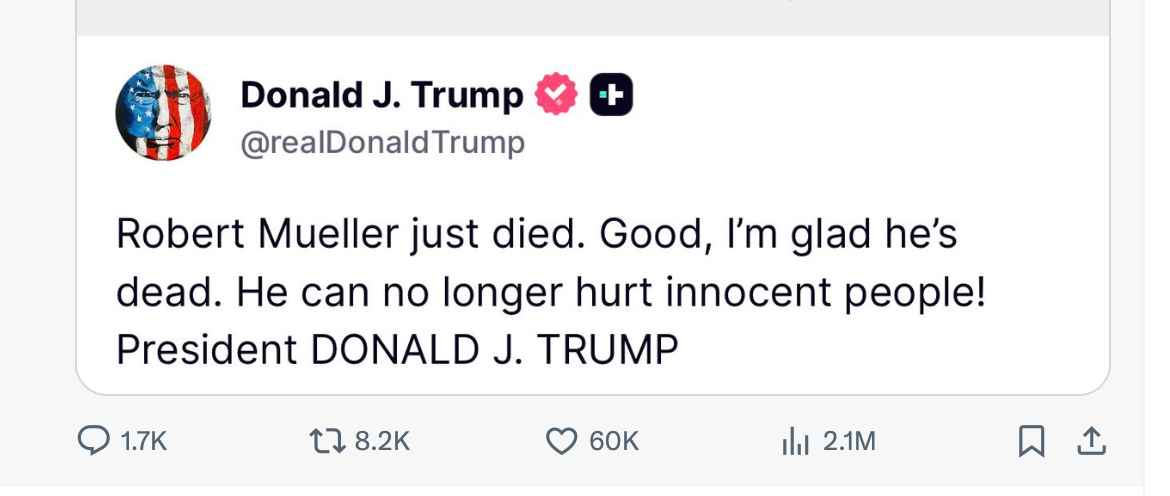
When I saw that Bob Mueller had died, it made me sad. When I saw that Donald Trump, just moments later, said he was glad he was dead, it made me sick.
Speaking of sick, who says “I’m glad he’s dead” publicly? A sick, deranged, despicable person who should not be within a million miles from the White House.
I remember seeing Bob Mueller at Ground Zero three days after 9/11. I was part of a press pool covering President Bush, Hillary Clinton, Rudy Giuliani and Mueller, whe had just been sworn in a few days earlier as the new head of the FBI. In that job, he restored the integrity of the Bureau, caught a lot of terrorists, and was, by all measures, the best director of the FBI in history.
He had earlier done a stellar job helping run the Justice Department, and then, late in his career, he left private practice and went back into government to prosecute local criminals in Washington, D.C., several levels down from where he had served before. That’s a public servant. A man of decency.
And there’s more: When his friends from Princeton were dodging the draft, Mueller went to Vietnam and won a Purple Heart.
Compare that to Trump, who told Howard Stern “my Vietnam” was fear of getting the clap. Now Captain Bone Spurs wants tanker captains to show courage in the Straits of Hormuz.
Remember how Trumpsters tried to get anyone who didn’t express profound grief over the death of Charlie Kirk fired? Now they don’t bat an eye over Trump celebrating Mueller’s death. Imagine if someone at their kid’s school said he was “glad” that another kid died. Or someone at their company. The student would be sent to the school psychologist. The co-worker would likely lose his job. But they’re fine with it in the White House.
Yes, I was a little disappointed by the 2019 Mueller report. But Trump lied when he said he was exonerated. The report concluded that Russia tried to steal the 2016 election from Hillary, the Trump campaign knew about it, and on 10 separate occasions, they obstructed justice.
Mueller also said that he didn’t have enough to charge Trump with a crime. And that’s too bad. But even if he had, it wouldn’t have gotten Trump out of office. The Supreme Court would have just given the president immunity five years earlier.
So in the long view of history, Mueller should not be remembered for fumbling the ball on that. He should be remembered for a career of true public service.
When I think of Bob Mueller, the word that comes to mind is integrity. With Donald Trump, it’s depravity.

Here’s my short weekly conversation about historical context with Princeton professor Julian Zelizer. You can watch it live at 10:00 a.m. on Fridays.
(transcript via ChatGPT)
Edited transcript:
JULIAN ZELIZER
So Jon, I was teaching my class about the 1990s and I touched on Operation Desert Storm, which is, of course, when the United States, under President George H. W. Bush, launched a military operation to remove Iraqi troops under Saddam Hussein from Kuwait, where they had invaded.
At the same time, I was reading the news recently about pressure on war coverage coming from the administration. And part of what happened in Operation Desert Storm, the first major conflict since Vietnam, is the government did try to find ways to limit some of the negative coverage. They had a pool system where reporters were confined to certain areas and escorted by military officials. There were security clearances before a lot of things could be published. There were approved briefings, which were very choreographed in terms of what kinds of material from the conflict was being presented.
It became a big issue of that war—what kind of pressure was coming from the administration. So how do you think that compares to some of what we’ve been hearing about in the first few weeks with Iran?
JONATHAN ALTER
Well, first, just a couple of quick differences.
Iraq invaded Kuwait in August of 1990, and President George H. W. Bush then began a campaign of several months to build public support and also to have the time to move a very large ground force into the region. The operation, which lasted only 100 hours, took place in February of 1991.
So people had a long time to debate this. A lot were against it. Sam Nunn, a big hawk, was among those opposed to the Gulf War. A lot of Americans thought it was just a war for oil and that we shouldn’t risk lives to free Kuwait.
But they went ahead and did it, and at the time, the people in charge had more credibility than our leaders do today, and not just at the presidential level. Dick Cheney was secretary of defense, and he was actually, at that time, pretty well regarded. Colin Powell was the chair of the Joint Chiefs, and General Norman Schwarzkopf—”Stormin’ Norman”— was the commander of U.S. forces.
Schwarzkopf would give these briefings in Riyadh, Saudi Arabia, that were very complete, very detailed, and far superior to what we’re getting now from Hegseth.
So while there were restrictions, and most wars do have restrictions of one kind or another on press coverage, you didn’t see amateur attacks on the press like we’re getting from Hegseth and Trump. And the press wasn’t sucking up, but they were operating within the restrictions to try to tell their readers and viewers as much as they could about a fast-moving situation.
So there are always tensions in war. The saying goes, truth is the first casualty in any war.
But I think the difference this time is that there are no ground troops to embed with or to get a closer look with. And also, you have just no confidence at all that you’re getting a straight story from this administration.
When Schwarzkopf or Colin Powell would say something in those briefings, you couldn’t necessarily take it to the bank, but you could give them the benefit of the doubt that when they were describing the details of a military operation, they were basically giving you a pretty good sense of what happened. That’s not true nowadays.
JULIAN ZELIZER
And I’ll just add, then there was no context of the administration, as much as they might have distrusted or disliked the press, threatening them, threatening hosts, threatening stations, using the FCC as a weapon. That was not part of the Bush administration. It creates a really different context now.
JONATHAN ALTER
Correct. There was tension. But when Bush would complain about the press, it would be in the form of a campaign button: “Vote Bush, Annoy the Media.”
There’s a big difference between that and trying to trash anybody who dares criticize you.
One more thing:
Bush was at 90 percent popularity after the Gulf War, and a year and a half later, he’s beaten badly by Bill Clinton in the 1992 election. All of his support for that war just evaporated.
And Trump started well under 50 percent support for this war, and it’s not likely to go up. He could fall a lot further.
JULIAN ZELIZER
This is “Then and Now.” Jon, talk to you next week.


