
Fighting Wrongful Convictions
Rob Warden on Jesse Jackson, Fred Hampton, the death penalty, DNA exonerations and false confessions

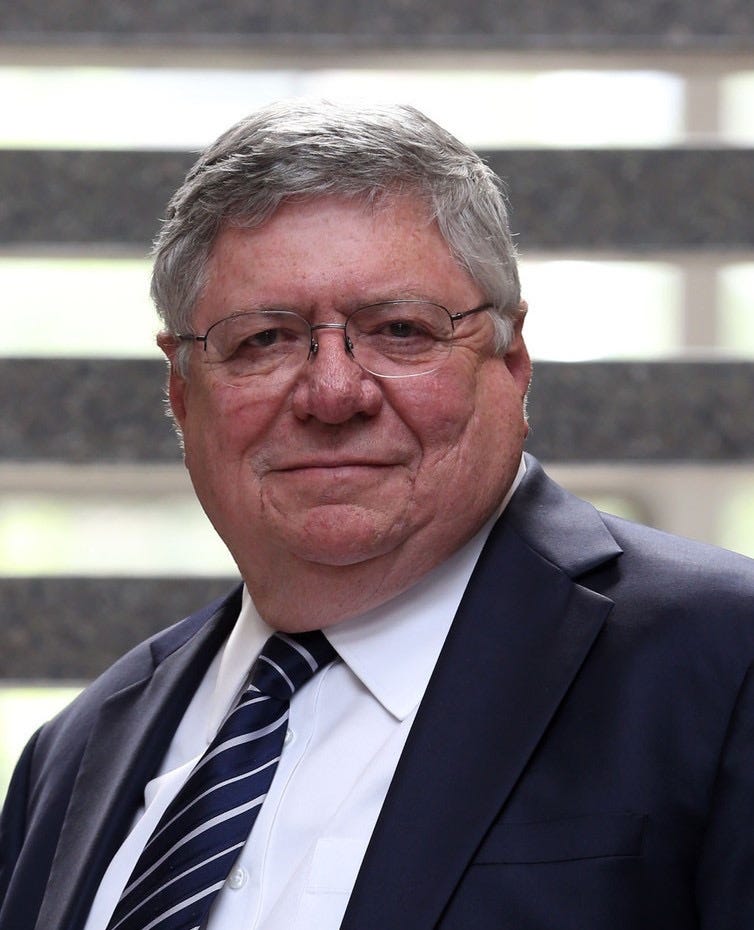
Rob Warden is a legend in Chicago journalism and in the national criminal justice reform movement. Born in Carthage, Missouri in 1940, he reported for a dozen years for The Chicago Daily News, one of the best-regarded afternoon newspapers in the United States. He broke exclusives on the first mass murderer, Richard Speck, and was on the scene at Fred Hampton’s apartment just a few hours after Hampton and Mark Clark were killed by Chicago police in 1969. After the Daily News folded in 1978, Rob broke important stories on FBI abuses for The Washington Post and founded Chicago Lawyer, which published landmark exposés on wrongful convictions in Illinois that led to scores of exonerations. He helped free six men on death row and was instrumental in ending the death penalty in Illinois, which set the pace for other states moving away from capital punishment. Rob co-founded the Center on Wrongful Conviction at Northwestern University School of Law, Injustice Watch, and the National Registry of Exonerations.
Full disclosure: Rob has been married for more than 40 years to my older sister, Jennifer Alter Warden. But nepotism played no role in why this interview runs so long. Promise!
JONATHAN ALTER:
One of the first stories you covered was the 1966 mass murder of eight student nurses by Richard Speck, which became one of the biggest murder cases in American history.
ROB WARDEN:
My then‑wife and I were going to visit her parents in Macomb, Illinois, and I was sitting at a stoplight in the town of Monmouth, Illinois, when WBBM radio broadcast that the killer of the young women had been identified [thanks to a survivor who hid under a bed] and that he was Richard Speck from Monmouth, Illinois! So I happened to be in a position to be first on the scene to report on who this guy was.
I found people who knew him, people who drank with him. I even found the doctor who delivered him. The police chief was very cooperative, so I had this great exclusive for the Daily News. I was then able to cover other aspects of the case, including what impact the then‑new Sam Sheppard decision [from the case that became The Fugitive] might have on the upcoming trial and the problems inherent in selecting a jury in such a highly publicized case.
JONATHAN ALTER:
Was that the first of what we would consider to be mass murders, which are now, sadly, almost commonplace?
ROB WARDEN:
The country had experienced nothing before on that scale. Shortly thereafter, there was the massacre at the University of Texas by Charles Whitman, which was a huge story too, but not as big as the Speck murders. It was one hell of a big story in its day.
JONATHAN ALTER:
What was your coverage like of the civil rights movement and Martin Luther King?
ROB WARDEN:
I worked briefly for the Kalamazoo Gazette before I was hired by the Chicago Daily News, and King had come to Kalamazoo, and I interviewed him there, so I was familiar with him before I arrived in Chicago. He was just then undertaking a major campaign in Chicago, and I was lucky enough to cover him appearing at churches on the West and South Sides. That is where I first got to know Jesse Jackson. I was there when King marched through Cicero [where he was stoned by racists], and I consider myself very fortunate to have been on the front lines there.
JONATHAN ALTER:
At that time, in 1966, Jesse Jackson was twenty-five years old. What was he like as a young guy?
ROB WARDEN:
Frankly, I didn’t know whether to take him seriously. The first time I saw him I was in a church with another Daily News reporter, a Black reporter named Burleigh Hines, and Jesse came in with an entourage. I did not know who it was. I said, “Who is that?” and Burleigh said, “That’s Jesse Jackson.” He [Jackson] seemed a little self-important at that moment, although later I came to respect him a great deal.
JONATHAN ALTER:
Set the scene for what it was like at Operation Breadbasket and, later, Operation PUSH.
ROB WARDEN:
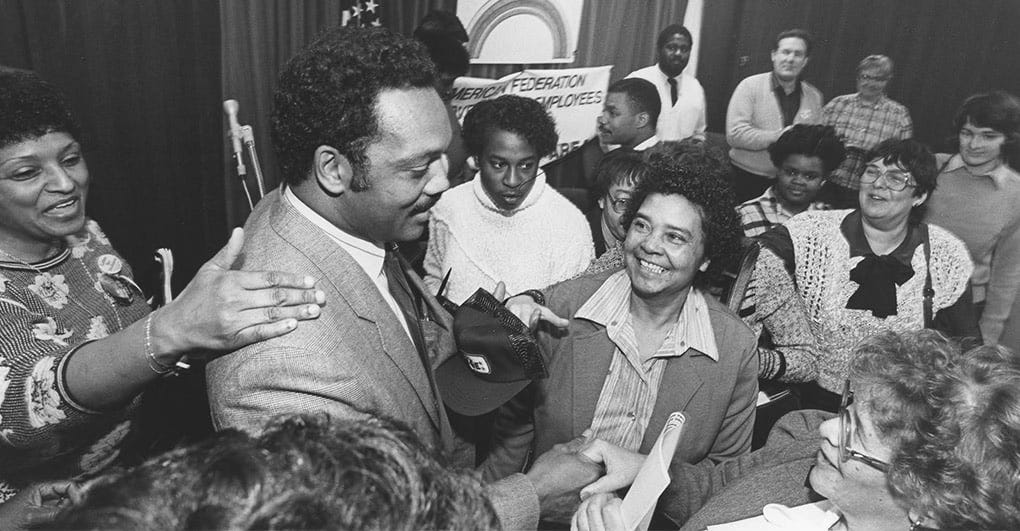
It was a church that had been a church of some other denomination before Jesse took it over. It was ingenious the way he set it up so that, no matter how small a crowd might be, it looked large from the vantage point of the cameras. It always appeared full. The cameras were focused on the podium, and people in the pews were ushered into the front area so that it was always “full.” Anytime you saw a photograph from there, it looked like a packed house. He did not let the cameras shoot from the other direction.
At any event, he would use his size and his body to push his way into the shot. He was a former football player, so he would always be seen on TV or in photos behind the newsmaker, no matter what the event was or how much connection he actually had to it. It takes a certain genius to do that. I was amazed he could pull it off. I always had in the back of my mind that he might be a self-promoter, but he was doing good stuff and was on the right side. And he was really funny, and that made him engaging in person.
JONATHAN ALTER:
Here’s part of my take on his big and important career:
I met him after you did — in 1976, when I was 19 and went with my mother to the South Side when she was running a losing campaign for lieutenant governor of Illinois. After I joined Newsweek in 1983, I interviewed him many times, but usually just for a few minutes at various news events where we crossed paths. I have a particular memory of him at a Newsweek lunch—he came often— in our corporate dining room at 444 Madison Ave. He was talking a blue streak — all compelling — so our owner, Katharine Graham, leaned over and cut his food so he could get in a few bites of chicken before it got cold. I loved that image: This aristocratic icon serving, in a nice way, this unique figure, born poor and out-of-wedlock.
Jesse was always good for a snappy quote I could use in the magazine. On Election Night 2008, he was famously seen crying in Grant Park, moved by Obama’s election, which he had helped make possible. Earlier in the evening, I talked to him for about 20 minutes standing on opposite sides of a rope line because I had a better ticket; he had pissed off the Obama team by being caught on an open mic trashing Obama earlier in the campaign. His comments to me were a mixture of envy and pride, as he recalled inspiring Obama to go into politics. This was partly true, though Chicago Mayor Harold Washington was a more inspirational figure for Obama.
He was a more complicated figure than King. He would picket a business and the picketing would stop only if the business didn’t just employ more Black workers, but also gave Operation PUSH a donation. It was a full-on shakedown. But in the long view of history, it put businesses on notice that if they didn’t do a better job integrating, they would be boycotted, and a lot of them made real efforts to diversify their workforce that they probably would not have made if they weren’t shamed into doing so.
Beyond being a phenomenal speaker and inspiration for big voter registration drives, Jesse’s legacy was that he reminded the Democratic Party to stay focused on poverty at a time when big donors didn’t want that. His catchphrase, “I am somebody” helped establish a sense of self-worth for the dispossessed, and “Keep hope alive” is hugely relevant today.
ROB WARDEN:
I got him involved in a case you remember well, the Roy Roberts case in Missouri. Roy Roberts was executed for a crime that I believe, and I think you believe, he did not commit.
JONATHAN ALTER:
Yep. In 1999, you tipped me off to this case, and I interviewed Roberts for NBC News in a Missouri prison the night before he was executed. There was a lot of reasonable doubt and real evidence that he wasn’t guilty of the crime. [helping kill a prison guard].
ROB WARDEN:
I asked Jesse if he would sign a letter to Missouri Governor Mel Carnahan [to stay the execution], and he did. [Carnahan ignored the plea and let the execution proceed]. Not long after that, we founded the Center on Wrongful Convictions [at Northwestern University School of Law], and Jesse was a frequent guest there. I was at Operation PUSH often. I would join Jesse for breakfast sometimes before the Saturday-morning breakfast, and we would bring clients, particularly Black clients, down to speak. On balance, he did more good than harm.
JONATHAN ALTER:
Let’s turn back the clock and talk about 1969. You and another reporter were among the first on the scene after the murder of Fred Hampton and Mark Clark by the Chicago police on December 4, 1969.
ROB WARDEN:
The raid occurred at about two in the morning and was conducted by thirteen Chicago police officers attached to the Cook County State’s Attorney’s Office under the direction of State’s Attorney Edward Hanrahan. I went there with Lu Palmer, a Black columnist for the Chicago Daily News, the next morning around 10:30 a.m. We did not get into the house, and I never did, but Bobby Rush [a Black Panther leader and future member of Congress] stood on the steps and said, “I want to make this one thing clear. This was a murder.” It was a tremendous moment. Later, I got to know a lot of the Black Panthers and Fred Hampton’s brother and his girlfriend, who adopted the name Akua.
We staffed police headquarters around the clock in those days. There were reporters at 11th and State Street 24/7, and the City News Bureau had a reporter there, so word of the raid would have come across quickly. We did not realize immediately how bad the carnage was.
Hanrahan was indicted by a Cook County grand jury, and that case was dismissed. Then a federal civil suit was filed. The lawyers were people who became good friends of mine, Flint Taylor and Jeffrey Haas. It was a remarkable trial before Judge Joseph Sam Perry. I had very little respect for Judge Perry. At one point, Jeff Haas complained about something, and Judge Perry said, “You’re not going to get your way in this courtroom.” Haas said, “I know, Your Honor. My way is a fair trial. It’s clear I’m not going to get it in this courtroom.” Judge Perry shot back, “You’re right. You’re not.” It became the longest-ever civil trial in federal court in Chicago. Perry threw it out, and the U.S. Court of Appeals for the Seventh Circuit finally put it back together. There was a settlement of about $750,000 for the families.
Hanrahan wasn’t a good guy, but he wasn’t as bad as advertised. The FBI orchestrated the whole thing behind the scenes. FBI informant William O’Neal provided the floor plan of the apartment where the killings took place. He actually brought the weapons that the Panthers had to the apartment. He even built an electric chair to deal with informants. An FBI informant plotting to electrocute informants. He was really a piece of work.
JONATHAN ALTER:
Even worse than in Judas and the Black Messiah?
ROB WARDEN:
Much worse in real life. The day after the raid, the State’s Attorney’s Office released photographs to the Chicago Tribune supposedly showing bullet holes in walls and woodwork that would have come from the direction of the Panthers. Lu Palmer got into the house and found out that these were not bullet holes; they were nail heads. The Tribune had done a full page of these photographs and bought it hook, line, and sinker. We were able to expose in the Chicago Daily News that these were nail heads, not bullet holes.
JONATHAN ALTER:
In the 1970s, you did some of the first work exposing FBI files and COINTELPRO. Talk about that, the Elvis story, and some of the other stories you got from Freedom of Information Act (FOIA) requests.
ROB WARDEN:
COINTELPRO surfaced earlier, but it became a big part of the Panther trial that I covered. J. Edgar Hoover had said that the goal of the FBI was to prevent the rise of a Black Messiah who could electrify and unify the Black nationalist movement, and he set out to destroy it with counterintelligence.
One of the great stories I discovered under FOIA was that Hoover was upset about criticism from Dick Gregory, the Black comedian in Chicago. Gregory criticized Hoover all over the place and was very critical of the crime syndicate. Hoover wrote a memo to the Special Agent in Charge of the Chicago FBI office saying that we should alert La Cosa Nostra to the fact that Dick Gregory was making disparaging remarks about them. He wanted to get the crime syndicate upset and maybe have them take out Dick Gregory. I don’t think the crime syndicate would have done anything like that, but it was indicative of Hoover’s craziness.
Dick Gregory was living out east. I called him, and he came to Chicago. I went out to O’Hare to meet him and showed him the documents. He said, “Do you realize what you have here? You have a document that says the head of the world’s leading law-enforcement agency is proposing that they contact the world’s largest criminal organization so that the two of them can work together to kill a comedian.”
JONATHAN ALTER:
You broke the story about Elvis Presley wanting to join law enforcement.
ROB WARDEN:
The story recounted how, in 1970, Elvis went to FBI headquarters when he was in Washington. He offered to become an informant. He blamed the Beatles for what he called the “unkempt appearance” of many youth and thought the Beatles were responsible for a lot of what was going on with the youth counterculture.
Someone in the FBI asked whether they should introduce Elvis to the director and Clyde Tolson [Hoover’s deputy and lover], and the answer came back that Elvis was definitely not the sort of person the director should meet. Nixon, by contrast, was happy to see Elvis and famously gave him some kind of law enforcement badge.
I also found documents showing that Hoover had a grudge in the 1940s against Illinois Governor Adlai Stevenson for extremely mild criticism of the administrative ability of FBI agents. So he kept a file on him when he ran, twice, for president.
The FBI did wiretapping and black-bag jobs where they literally burglarized liberal or progressive organizations and stole their files. They set out to “neutralize” critics of the government, particularly of the FBI.
We found out about the Chicago Police Department’s “Red Squad” infiltration of Jesse’s Operation PUSH, the Citizens Action Program, and other groups through a lawsuit filed by a former African American police officer named Renault Robinson.
JONATHAN ALTER:
Compare the power of the FBI under Kash Patel and Trump to do damage versus Hoover’s FBI.
ROB WARDEN:
In many ways, it is comparable. I am not suggesting that the Kash Patel FBI is out doing black-bag jobs or trying to neutralize organizations; I have not seen evidence of that. But in the larger sense, it is a corrupt organization used to serve the interests of the President of the United States and to make life harder for critics.
Trump’s instinct is always to use law enforcement as a blunt instrument against enemies and to demand personal loyalty from prosecutors and investigators. That’s not new in American history, but he is more open and shameless about it. He has talked about executing drug dealers and bringing back extremely harsh forms of punishment.
When you combine that with someone like Kash Patel placed in a key role over the Justice Department or the FBI, you get a real risk of the machinery of criminal justice being turned into a political weapon. Under Hoover, the FBI abused its power to go after civil-rights activists, anti-war protesters, and critics like Dick Gregory. Under Trump, you see the same impulse, but with the benefit of modern surveillance tools and a media ecosystem that can amplify disinformation instantly.
The one encouraging historical lesson is that institutions can be repaired. After Hoover and Watergate, Gerald Ford and Attorney General Edward Levi were able to restore a fair amount of integrity to the Justice Department and the FBI. It took political will, but not decades. The damage that Trump, Pam Bondi, and Patel have done to public trust is real, but it is not irreversible if future administrations are serious about rebuilding norms of independence.
JONATHAN ALTER:
You co-wrote a book called Greylord: Justice, Chicago Style, about eye-popping corruption in Cook County courts, where the Feds had a judge wear a wire to document wrongdoing. I love the story about a hungover judge that you open the book with. And you know it by heart.
ROB WARDEN:
“Ray Sodini awoke late.
His head hurt. His eyes ached. His tongue was dry as a blotter, and it stung from cigarettes.
Ray Sodini had a hangover.
He reached for the telephone. He dialed the number, his fingers twitching. It was answered at the other end.
“I was out late last night,” said Sodini. ‘Tell Cy to put on the robes and do the bum call.’
Then Raymond C. Sodini, one of about 350 judges of the Circuit Court of Cook County, pushed his head into his pillow, and closed his eyes. He had borrowed another hour or so before he would have to get up and go to his courtroom.”
This was a county judge telling a Chicago police officer to put on the judge’s robes and go out and conduct that morning call of people who had been arrested overnight for vagrancy and stuff like that. So we literally had a cop sitting on the bench pretending to be a judge. In the case of one defendant he didn’t like, the cop slammed down the gavel and sentenced the poor man to…death. A joke, of course.
JONATHAN ALTER:
You became editor of Chicago Lawyer and did pathbreaking reporting about cases of wrongful conviction.
ROB WARDEN:
I started Chicago Lawyer in November 1978 after the Chicago Daily News folded, and I had begun working [part-time] for The Washington Post. I got a letter from someone on death row who claimed to be innocent. It was compelling, and we looked into it. It ultimately led to the exoneration of this defendant and two others on death row, Dennis Williams and Verneal Jimerson. They were the first ones. Later, an Illinois Supreme Court decision reversed a capital case involving two defendants, Perry Cobb and Darby Tillis, whose stories we first told.
In total, Chicago Lawyer’s journalism was responsible for six of the first seven people to be released from death row after the Illinois death penalty was restored in 1977. The seventh was a result of reporting by Peter Rooney at the Champaign News-Gazette. The first seven men off Illinois’ death row were all freed as a result of journalistic exposés. That’s not even mentioning the scores of exonerations in non-death penalty cases.
JONATHAN ALTER:
So then Dave Protess begins teaching an undergraduate class at Northwestern, with your help, and students start looking at cases of wrongful conviction. And you do something similar at Northwestern Law School. How did that lead to changes in the death penalty?
ROB WARDEN:
The idea was to have students reinvestigate possible wrongful-conviction cases. That class led to several exonerations. The cases the students worked on, and the earlier cases from Chicago Lawyer, helped build a record that the system was making unacceptable mistakes. Eventually, that record became impossible for the politicians to ignore.
JONATHAN ALTER:
Barry Scheck’s Innocence Project specializes in DNA, so he gets more ink, but in fact, you were responsible for the first DNA exoneration in the world, which got huge publicity at the time.
ROB WARDEN:
We did the first DNA exoneration in 1988, which was a result of my exposé of the Gary Dotson case. That case involved “the rape that wasn’t,” as I called it, of this young lady, Kathy Webb. She became a born-again Christian and told her minister that she concocted this rape allegation and that a guy [Dotson] had been in prison for it; she felt terrible about it and wanted to fix it. She came forward, and the Cook County State’s Attorney’s Office said, “Oh, she’s crazy.”
At first, I didn’t really know what to make of this. She was only 16 or 17 when this happened, and how could she make up this incredible story? But when I got the transcript, I discovered that the forensic scientist lied to the jury. He told them that this rape could only have been committed by a “B secretor”—that is, somebody with type B blood, who secretes their blood antigens. Well, it turned out that Kathy Webb herself was a B secretor, so in fact, this “expert” had wrongly cut down the universe of potential rapists. It turned out there was no rapist because she’d had consensual sex with her boyfriend, as DNA ultimately proved.
JONATHAN ALTER:
Let’s talk about Governor George Ryan, who was greatly influenced by a play, The Exonerated, that you arranged for him to attend in Chicago. How did a Republican governor become the man who essentially ended the death penalty in Illinois?
ROB WARDEN:
Ryan came into office as a supporter of the death penalty. He had voted for it and had no qualms about it. But as governor, he was confronted with the fact that more people had been exonerated from Illinois death row than had been executed. The Chicago Tribune series and our work at the Center on Wrongful Convictions played a big part in bringing those cases to his attention.
He appointed a commission to study the capital-punishment system, and that commission came back with a long list of serious problems—bad lawyering, unreliable jailhouse informants, false confessions, mistaken eyewitness identifications, and racial disparities.
On the way out of the play, Ryan said publicly that he would act. He had reached the conclusion that the system could not be fixed. In January 2003, he commuted all remaining death sentences to life or less and pardoned four men outright on the grounds that they had been tortured into false confessions. That was an extraordinary act.
JONATHAN ALTER:
And then you helped convince Governor Pat Quinn to finally abolish the death penalty in Illinois.
ROB WARDEN:
Yes. Quinn signed legislation in 2011 that abolished the death penalty altogether in Illinois. By then, the political climate had shifted enough that it was possible. Ryan’s blanket commutations had taken the immediate pressure off, but Quinn’s action made it permanent in this state.
JONATHAN ALTER:
Let’s talk about false confessions. That’s an area where you and others in Chicago really changed the national understanding of how they happen.
ROB WARDEN:
False confessions were once regarded as almost impossible. The notion was, “Why would anyone confess to a crime they didn’t commit?” But going back to the Central Park Five and many other cases, we now know that with enough pressure, people do falsely confess.
Chicago turned out to be a kind of laboratory for this because of the number of proven false-confession cases that came out of here. Some involved outright torture under Jon Burge and his detectives — beatings, suffocation, electric shock. Others involved psychologically coercive interrogations that followed the Inbau–Reid method that had been developed in Chicago, which encouraged long, manipulative questioning in which police lied about evidence and wore suspects down until they said what the police wanted to hear.
DNA testing revealed much of this. You had cases where someone had confessed in great detail, and then DNA or other conclusive evidence showed that he could not have committed the crime. When that happens enough times, it becomes impossible to dismiss as an anomaly.
JONATHAN ALTER:
How did the Supreme Court and figures like Justice John Paul Stevens fit into this story?
ROB WARDEN:
Justice Stevens, who was from Chicago, evolved over time into a strong critic of the death penalty. In Baze v. Rees and later in Glossip v. Gross he made it clear he had come to believe the death penalty was unconstitutional in practice. He cited the risk of executing the innocent and the arbitrary way the punishment was applied.
At the Supreme Court, more generally, you see a long arc. In the 1970s, the Court briefly struck down existing death penalty statutes in Furman v. Georgia, then allowed revised schemes in Gregg v. Georgia. For a time, it seemed as though procedural safeguards would be enough. But the wave of exonerations, including in Illinois, made it clear those safeguards weren’t working. Stevens became a kind of bellwether of that realization.
JONATHAN ALTER:
How close did the United States come to broader abolition of the death penalty, and where do you think things stand now?
ROB WARDEN:
For a while, around the late 1990s and early 2000s, it looked as if the country might be moving toward eventual abolition. Executions declined. States imposed moratoria or narrowed their statutes. Public support dropped, in part because people were seeing these exoneration stories — DNA, false confessions, jailhouse snitches getting exposed.
We didn’t get national abolition, but the geography of the death penalty changed. It became concentrated in a handful of states and even a handful of counties. Illinois, New Jersey, New Mexico, and others abolished it; other states kept it on the books but used it rarely, if at all. Where it remains active, it is often driven by particular prosecutors and judges rather than any rational policy.
JONATHAN ALTER:
You mentioned the innocence movement and journalism. How do you assess the state of journalism now compared to when you started, particularly for uncovering wrongful convictions?
ROB WARDEN:
It is very troubling. There would not have been an innocence movement without the media. Investigative journalism was essential to uncovering wrongful convictions. Larry Green and I at the Chicago Daily News could spend three months on a story and sometimes come up dry. The investment might be thousands of dollars, and sometimes it didn’t pan out.
It was common for major newspapers to spend a year with two or three reporters on a project that produced a big series. Those were expensive undertakings, but they were possible because of big advertising revenue — real estate, automobiles, classifieds. The internet destroyed those revenue streams.
Local newsrooms have been hollowed out. There are exceptions and some excellent work still being done, but the capacity to take on long, resource-intensive investigations is much diminished. Podcasters and nonprofits can help fill part of the gap, but they don’t fully replace a strong local press corps that has people at the courthouse every day and the resources to dig in when something looks wrong.
JONATHAN ALTER:
Given everything you’ve seen — from Speck and King to COINTELPRO, Fred Hampton, Jesse Jackson, George Ryan, Trump — how do you think about the arc of justice in this country?
ROB WARDEN:
I have seen a lot of horror and a lot of courage. The criminal-justice system is capable of terrible injustice — torture, false confessions, wrongful executions, targeted surveillance — but it is also capable of reform when people push hard enough and shine enough light on what is happening.
Journalists, lawyers, activists, and some politicians have managed to expose abuses and free innocent people. Governors like George Ryan and Pat Quinn took real political risks to confront the death penalty. People like Jesse Jackson, despite their flaws, kept a spotlight on poverty and racial injustice.
The arc is not smooth or guaranteed, but there is progress. The challenge now is to defend the reforms that have been won and to keep building institutions strong enough to resist the next wave of demagogues who want to turn the machinery of justice into a weapon.

Here’s my short Then and Now convo with Princeton Professor Julian Zelizer, our latest weekly effort to convey some of the historical context of the news:
Rob Warden is an American hero and patriot. Thank you for this interview and shining a light on his amazing work and success.
Thanks for this terrific piece. More conversation between wisened, battle scared comrades than interview per se. Hopeful in spite of its messy self.